

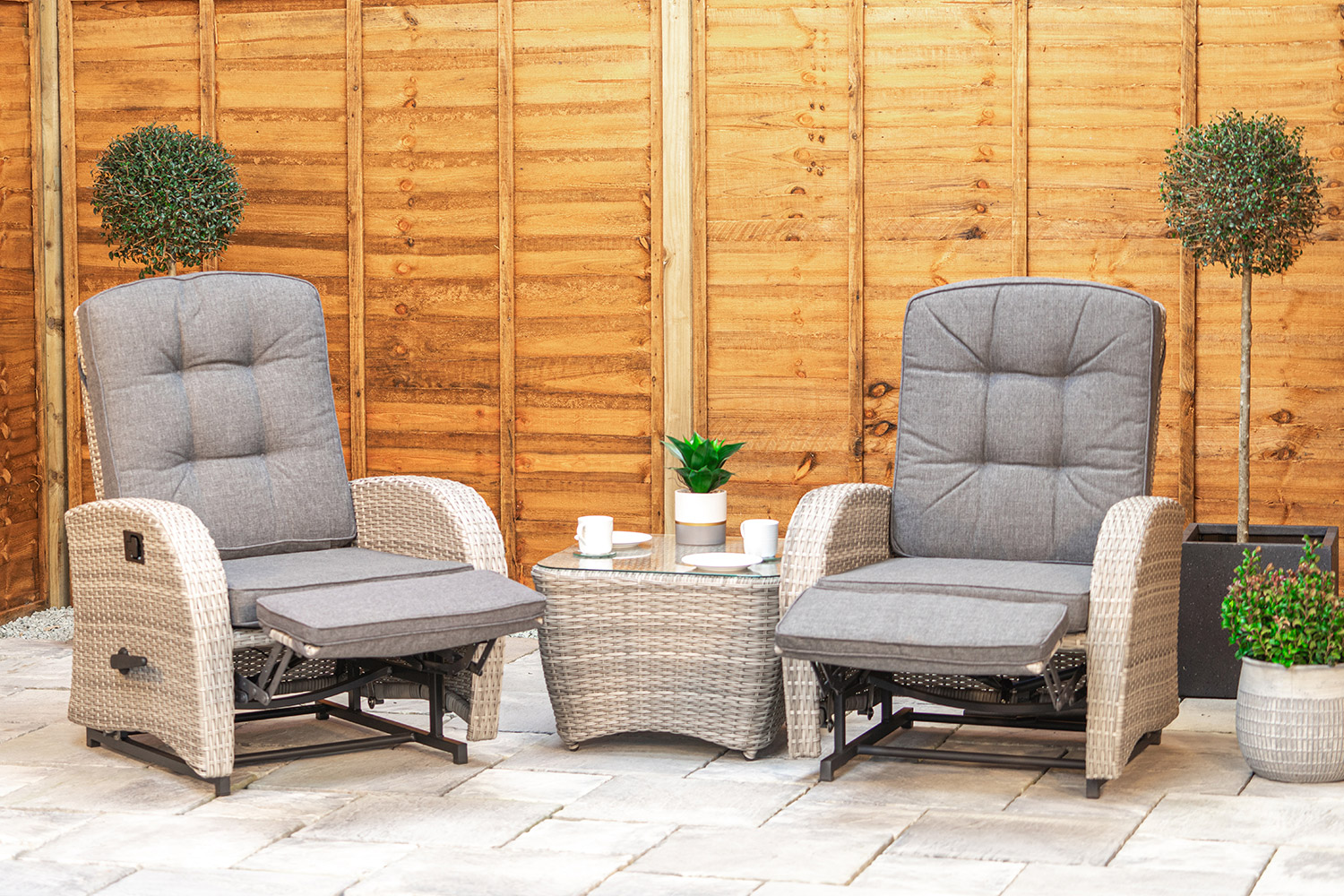
Good rattan-effect garden furniture lasts 10 to 15 years outside in the UK. A cheap steel-framed set often manages 3 to 5 before the frame gives out. We have sold rattan furniture from our garden centre in Sapcote since 2001, and in 2026 the gap between those two numbers still comes down to the same three build choices. This guide covers what they are, what fails first, and what to expect at year five and year ten.
What decides the lifespan of a rattan garden set?
Lifespan is set by three things: the metal in the frame, the gauge of the woven strands, and how the cushions are treated.
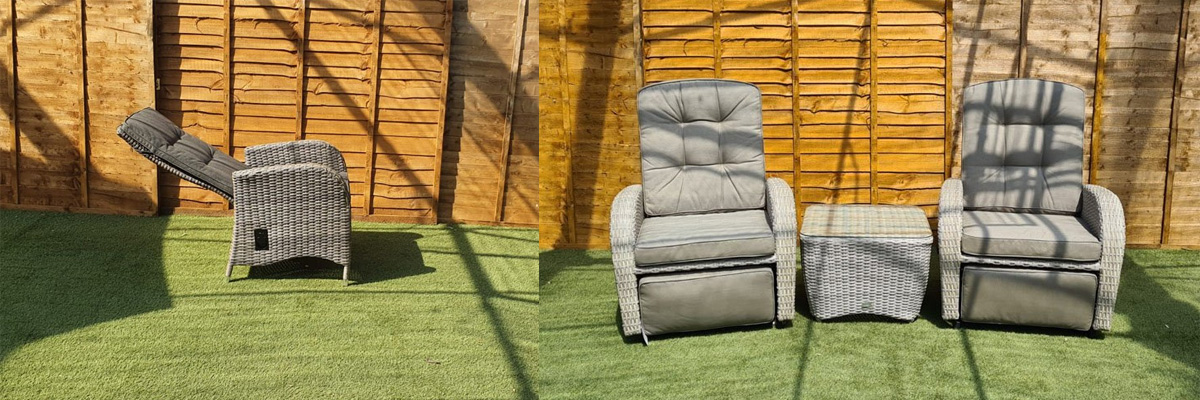
The weave gets all the attention, but modern outdoor rattan is a synthetic resin strand woven around a metal frame, and it is usually the frame, not the weave, that decides when a set goes to the tip. Cushions are a consumable on every set at every price. So when someone in our showroom asks how long a set will last, we ask two questions back: what is the frame made of, and how thick are the strands?
Steel or aluminium frame: which lasts longer?
Frames are the biggest single factor. Steel rusts from the inside once its coating is scratched; aluminium cannot rust, whatever the UK weather does.
Budget sets use powder-coated steel tube: cheap, and sturdy on day one. Once the coating chips or gets scratched by patio grit, water reaches bare steel, rust starts at the welds and bolt holes, and spreads under the paint where you cannot see it. By year three the legs feel gritty; by year five the joints can let go. To be fair to steel: under a covered porch, or for a couple of summers in a rented place, it does the job for less money. Aluminium costs more, which is why cheaper sets avoid it, but it cannot rust. Scratch it, leave it out in the rain, it does not care. Every set we sell is aluminium-framed for exactly this reason.
Does the thickness of the weave matter?
Thickness decides how the weave copes with sun and strain. Our strands are 0.2mm thick, double the typical, which is why seats stay taut.
Most rattan on the market is woven from strands around 0.1mm thick. Thin strands are lighter and cheaper to make, and for a set that lives in a conservatory or goes into the shed each October they can be a reasonable buy. Left outside, thin strands are the part that ages: summer sun makes them brittle, seat panels stretch and sag where people sit, and by year four you see pale cracks along the arms. A 0.2mm strand carries twice the material, so it flexes without stretching and shrugs off the odd belt buckle or pet claw. It is a difference you cannot see in a photo but can feel when you press on a seat panel.
Does rattan garden furniture fade in the sun?
Fading is a resin-quality problem rather than a rattan problem. Cheap surface-dyed strands chalk and lighten; UV-stabilised, through-coloured weave holds its shade.
Ultraviolet light breaks plastics down. Cheap weave turns chalky and grey on the sun-facing side within a couple of summers, often unevenly: bleached arms, dark backs. Better weave has UV stabilisers mixed through the resin, and the colour runs through the strand rather than sitting on its surface, so there is nothing to peel or chalk off. Our weave is made that way, and fade complaints are rare. Honestly though, ten years of direct south-facing sun can soften any weave a shade; you would only spot it beside a new set, and it is cosmetic, not structural.
What fails first, and what still works at ten years?
Failure follows a set order on every rattan set we have seen since 2001, and the frame decides how far down the list you get.
- What fails first (years 1 to 2): cushions. Budget covers thin out, zips pull, and pads left outside in rain show mould spots by the second spring.
- What fails by year 5: steel frames rust at the welds and leg bottoms where water sits, and 0.1mm weave turns brittle, cracks pale and sags at the front edge of the seats. This is the age most throwaway sets get skipped.
- What still works at year 10: on an aluminium-framed, 0.2mm-weave set, everything structural. The frame is sound, the weave is taut, the glass tabletop is fine. You will probably be on your second set of cushions, and the colour may have softened slightly. We have had display sets stand outside for eight years and more without a structural fault.
Which parts wear out, and when?
Parts age at different speeds. The frame and weave should outlast everything else; cushions are the consumable, whatever the label says.
| Component | Typical lifespan | What shortens it |
|---|---|---|
| Aluminium frame | 15+ years | Very little. Knocks can chip the finish, but chips stay cosmetic because aluminium cannot rust |
| Steel frame (budget sets) | 3 to 5 years | Any scratch in the coating. Rust starts at welds and bolt holes and spreads under the paint |
| 0.2mm woven strands | 10 to 15 years | Years of direct sun slowly soften the colour; pet claws and sharp edges can cut single strands |
| 0.1mm woven strands | 3 to 6 years | Summer sun makes thin strands brittle; they crack pale and sag at the seat edges first |
| Cushions | 3 to 5 years | Rain and damp storage. Mould ends more cushions than worn fabric ever does |
| Glass tabletop | Indefinite | Impacts: dropped parasol bases, tables toppling in wind. Age does nothing to it |
Does rattan furniture need covering in winter?
Covering is optional for the furniture itself. Aluminium-framed rattan lives outside all year; a breathable cover simply saves you the spring scrub-down.
The furniture we sell stands outside from January to December; frost, rain and snow do not harm the frame or the weave. What winter leaves is grime: algae film on the shaded side, bird mess, leaf stains worked into the weave. A cover keeps that off and turns the spring clean from an hour with a brush into a ten-minute wipe. One warning: a cheap non-breathable tarpaulin traps condensation and grows the very film you were trying to avoid, so use a breathable one. We stock breathable furniture covers shaped for most set sizes.
What should you do with the cushions?
Cushions are the one part of a rattan set that cannot live outside all year, and no label on any product listing changes that.
You will see garden cushions sold as waterproof. We would not put that word on ours; in 25 years we have never met a cushion that earned it: fabric can be shower-resistant, but the foam inside soaks up prolonged rain and dries too slowly to beat mould. From October to March, keep cushions in a shed, garage or blanket box indoors. In summer, leave them out by all means; just stand them on end to drain after a proper downpour and let them dry before stacking. Do that and a decent set of cushions gives you four or five summers instead of two.
How do you get the full fifteen years?
Fifteen years asks little of you: wash the set twice a year, keep cushions dry, and buy the right frame first time.
- Wash the frame and weave with warm soapy water in spring and autumn; a soft brush lifts grime out of the weave. No jet wash up close.
- Bring cushions indoors from October to March.
- Check the plastic feet each spring and replace any that have split.
- If you can, keep the set out from under trees. Sap and bird mess are the hardest stains to shift.
The rest is decided the day you buy: check the frame metal, ask for the strand gauge, and see how long the seller backs it. Every set in our rattan garden furniture range comes with a 3-Year Guarantee as standard (one year is typical elsewhere), Delivery Included and a 30-day money back guarantee that covers your delivery costs too. Or come and lean on the sets yourself at our Sapcote showroom in Leicestershire, open seven days and rated 4.4 stars from 2,561 Google reviews.
Rattan furniture lifespan FAQs
Can rattan garden furniture stay outside all year?
Yes, provided it is built on an aluminium frame with UV-stabilised weave. That combination is unaffected by rain, frost and snow, and our sets stay outside all year at customers’ homes and at our own showroom. The sets that suffer are steel-framed budget ones, where winter moisture finds every chip in the coating.
Do rattan cushions need to come in?
Yes. Whatever a product listing says, no garden cushion is genuinely waterproof: the foam inside absorbs prolonged rain and dries too slowly to stop mould. Keep cushions in a shed, garage or indoor box from October to March. The furniture itself can stay out.
How can you tell how long a rattan set will last before you buy?
Three checks tell you most of it: the frame metal (aluminium cannot rust; coated steel eventually will), the strand thickness (0.2mm is double the typical 0.1mm), and how long the seller backs it (ours carry a 3-Year Guarantee; one year is standard elsewhere). A seller expecting ten years will answer all three happily.
Is it worth covering rattan garden furniture over winter?
Worth it for the cleaning, not for survival. Aluminium-framed rattan comes to no harm uncovered, but a breathable cover keeps algae, bird mess and leaf stains off, so spring set-up is a wipe rather than a scrub. Avoid non-breathable tarpaulins, which trap condensation and cause the green film you are trying to prevent.